- Published On: 18 August 2026

Categories
Featured posts
- Real time insight into plant responses
Understand how crops react to inputs as conditions change - Data-driven confidence
Support farmer and advisor decisions with objective plant data - Smarter product and practice optimisation
Improve formulations, recommendations, and on-farm performance - More resilient crop management
Reduce guesswork and respond earlier to emerging stress

Vivent Biosignals x Van Schie x Ledgnd
Van Schie prevents winter leaf damage and saves 30% energy through plant driven growing.
Van Schie prevents winter leaf damage and saves 30% energy through plant driven growing.
Van Schie has built a reputation over 40 years as a specialist in potted lilies. What started as 500 m² of potted lilies has grown over the years into 5 hectares. In 2018, the product range was expanded with Chrysanne®, high-end potted chrysanthemums for the premium segment.
MyLedgnd is a data platform for greenhouse horticulture, developed by the Dutch company Ledgnd. The system combines data from climate computers, sensors, and plant feedback into a single, user-friendly dashboard.

“You’ve been growing based on intuition and experience for years, so it’s quite exciting and a bit daunting to let go of that and start truly steering based on data.”

Marcel van der Voort, Van Schie

Agronomic challenge
During the winter months, Van Schie experienced recurring leaf damage in the lower parts of its chrysanthemum crop. Despite intensive climate management aimed at improving plant quality, the issue persisted. The cultivation strategy focused on stimulating transpiration and activity through additional pipe heating, air movement and ventilation. While these measures were intended to strengthen the crop, plant data revealed the opposite effect. The combination of relatively low light levels and an active climate strategy continuously stimulated growth and transpiration, without providing the plant with enough energy to support that activity.
Using plant feedback sensors from Vivent Biosignals and the Ledgnd (MyLedgnd) data platform, Van Schie discovered that the plants were being structurally overloaded. This insight would not have been visible through climate data alone.
Results and client benefits
In 2025, a deliberate shift was made to let plant data lead all cultivation decisions. Based on continuous insights from the MyLedgnd platform by Ledgnd, climate strategies were adjusted to better match plant needs. Temperatures were reduced relative to available light levels, humidity corrections were applied more cautiously, and overall the crop was given more physiological rest. As a result, structural leaf damage during the winter period was eliminated.
By combining climate and operational data from Ledgnd with plant feedback signals from Vivent Biosignals, Van Schie gained a much clearer understanding of how the plant responds to light, climate, and steering interventions in real time.
Beyond quality improvements, the data-driven approach also delivered a significant efficiency gain. Energy consumption was reduced by 30%, driven by less intensive use of heating and ventilation systems and fewer unnecessary climate corrections. By avoiding over-control, energy was only used when the plant could actually respond. As a result, cultivation became not only more stable and predictable, but also considerably more energy efficient.
From claims to quantified proof
Moving beyond trial-and-error toward evidence-driven agronomy
Climate data shows the conditions present in the greenhouse. Plant feedback adds an additional layer of insight by revealing how the crop actually experiences those conditions.
By integrating plant feedback into daily cultivation decisions, Van Schie was able to align climate control more closely with the actual needs of the crop. Rather than steering solely based on environmental conditions, decisions were guided by how the plants themselves responded.
The result was not only healthier plants, the elimination of recurring leaf damage and a 30% reduction in energy consumption, but also a cultivation strategy that became more stable, predictable and efficient.
Why it matters
This case demonstrates the value of plant-led growing. By gaining real-time insight into plant responses, growers can optimize crop performance while avoiding unnecessary use of energy and other resources. A better understanding of how plants respond enables better decision-making, higher crop quality and more sustainable production.
Plants know best — and now they can show it.
“By avoiding overactivation, you prevent energy from being used at times when the plant cannot make use of it. By aligning more closely with the plant’s needs, you can use energy more efficiently.”
Ramon de Vrie, Ledgnd

Vivent plant sensors enable:
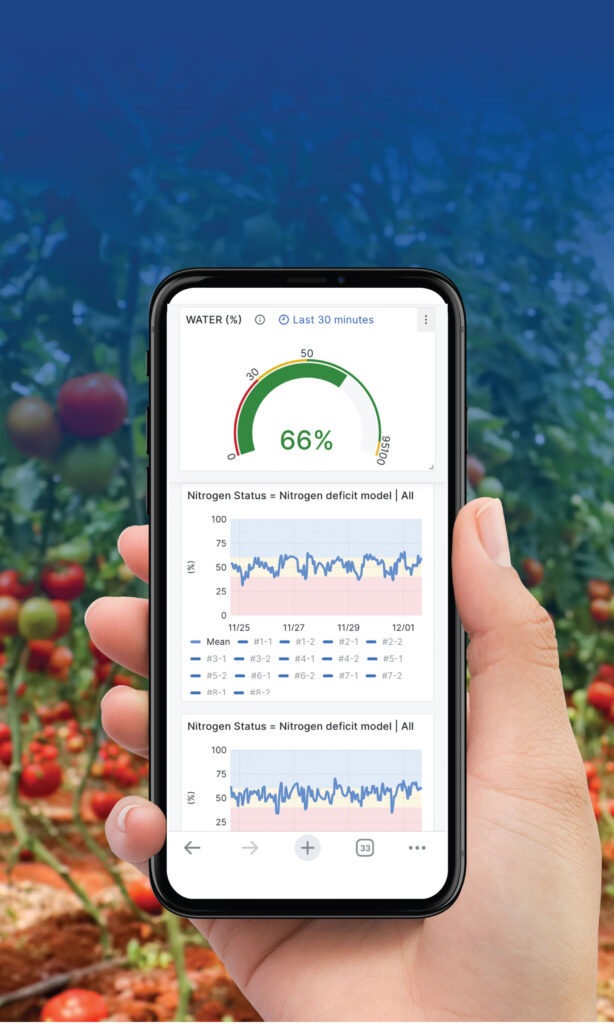
See how crops respond, optimise products and practices, and make more confident decisions, based on plant data, not guesswork.
Get in touch with us.
Fill out the form below or book a meeting directly with one of our team members!
Let’s connect to explore the future of agriculture together!
Plants are talking, we let you listen in.

Editor’s pick
- Crops were not growing as strongly or consistently as expected
- Soils showed room for improvement in terms of biological activity and structure
- Yields and plant resilience were not keeping pace with increasing effort and input costs
- More inputs did not reliably translate into better outcomes
- Fields managed under the farmer’s current best practice (control)
- Adjacent fields treated with Symactiv biostimulant
- Plant Balance Index (PBI) – a real-time indicator of plant adaptation and stress
- Water status
- Nutrient uptake dynamics
- Responses to temperature, humidity, and extreme weather
- In both potatoes and tomatoes, Symactiv-treated plants spent ~7% more time in the optimal Plant Balance range
- Treated plants adapted faster and more consistently to cold, wet, hot, and dry periods
- Differences became most pronounced during weather stress and extreme conditions, where resilience matters most. Better water status under stress
- Symactiv-treated crops showed better water status during high temperatures and low humidity
- Improvements were especially visible during prolonged warm and dry periods, when untreated plants became less stable
- In potatoes, treated plants showed higher Calcium and Phosphorus availability, particularly from mid-season onwards
- In tomatoes, Nitrogen, Phosphorus, and Potassium status improved significantly in treated plants from mid-August
- Nutrient uptake was strongest under cooler and wetter conditions, aligning with Symactiv’s soil-biology-driven mode of action
- Prove product performance under real conditions
- Optimize recommendations
- Accelerate adoption with confidence
- Real time insight into plant responses
Understand how crops react to inputs as conditions change - Data-driven confidence
Support farmer and advisor decisions with objective plant data - Smarter product and practice optimisation
Improve formulations, recommendations, and on-farm performance - More resilient crop management
Reduce guesswork and respond earlier to emerging stress
European Innovation Project
Autonomous, AI-driven crop management based on electrophysiological plant signals
Duration
10/2025 – 03/2028
About this project
Autonomous, AI-driven crop management based on electrophysiological plant signals
The project focuses on the practical development and validation of innovative biosensors and AI software that analyze electrophysiological signals from plants for the early detection of stressors. By enabling direct, real-time feedback from the plant, growers can implement more targeted, efficient, and sustainable cultivation interventions. This contributes to higher yields, reduced resource use, and a future-proof, data-driven agriculture and horticulture sector.


Peelkroon
Zachtfruit Schalkwijk

Medegefinancierd door de Europese Unie
See how crops respond, optimise products and practices, and make more confident decisions, based on plant data, not guesswork.
Get in touch with us.
Fill out the form below or book a meeting directly with one of our team members!
Let’s connect to explore the future of agriculture together!
Plants are talking, we let you listen in.
Symactiv x Vivent Biosignals x Jucker Farm AG
Quantifying the Impact of Soil Biology on Crop Performance
Symactiv is a Swiss biostimulant provider focused on restoring soil biology to turn depleted soils into productive, resilient growing systems. By rebuilding biological balance underground, Symactiv helps crops access water and nutrients more efficiently, delivering consistent performance year after year.
Jucker Farm AG, located near Pfäffikersee in Switzerland, is a progressive vegetable producer growing potatoes and tomatoes under demanding climatic conditions. Like many growers, Jucker Farm continuously evaluates new agronomic solutions that can improve crop resilience and input efficiency without adding operational complexity.

“Using Vivent’s solution, we could see when and why our biostimulant makes a difference. We were delighted to get quantified evidence of the benefits in water and nutrient status for crops treated with Symactiv.”

Philippe Schläpfer, Symactiv Co-founder and CTO

Agronomic challenge
Despite implementing regenerative practices and maintaining soils in good apparent condition, the farm faced several persistent challenges according to standard crop analysis:
Our approach
To objectively quantify the impact of Symactiv’s soil enhancer, we deployed Vivent’s plant-based sensing technology directly in the field.
Across potato and tomato trials, Vivent plant sensors were installed in:
Rather than relying solely on yield or visual assessments, Vivent Biosignals continuously monitored:
This approach allowed Symactiv and the farmer to compare treatments under identical environmental conditions, isolating the biological effect of the biostimulant.
Results and client benefits
1. Improved Plant Stability and Resilience
2. Better water status under stress
3. Enhanced nutrient uptake
From claims to quantified proof
Moving beyond trial-and-error toward evidence-driven agronomy
For Symactiv, these trials provided independent, plant-level evidence explaining why and when their biostimulant delivers value — strengthening both product development and customer communication. Treated plants showed substantial yield increases of approximately 15% compared to untreated plants for these specific crop cycles.
For Jucker Farm, the results validated Symactiv as a practical, field-ready solution that integrates seamlessly into existing operations while improving crop resilience.
Why it matters
This collaboration demonstrates how plant-based biosignal monitoring enables biostimulant providers and growers to move beyond trial-and-error toward evidence-driven agronomy.
By letting plants themselves report on stress, water, and nutrient dynamics, Vivent helps partners like Symactiv:
Plants know best — and now they can show it.
“Symactiv turns good ideas into practical, field-ready solutions. It fits seamlessly into our operations and has real potential for broader adoption.”
Martin Jucker, Jucker Farm AG

Vivent plant sensors enable:
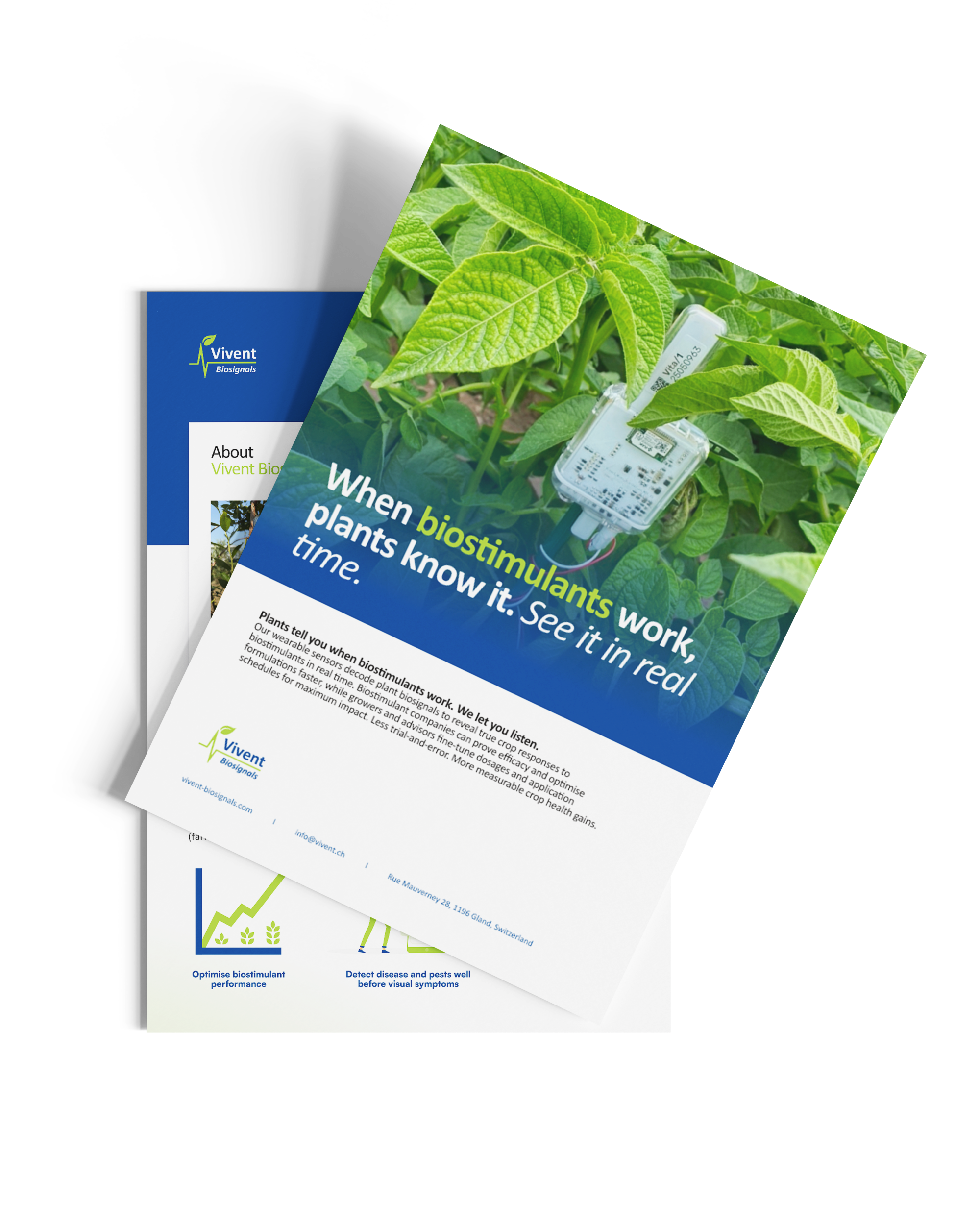
When biostimulants work, plants know it. See it in real time.
Our wearable sensors decode plant biosignals to reveal real-time crop responses to biostimulants. Biostimulant companies can demonstrate efficacy and optimise formulations faster, while growers and advisors fine-tune dosages and application schedules for maximum impact. Less trial-and-error. More measurable crop health gains.
Discover the added value of Vivent for biostimulants through field cases and more in our biostimulant brochure.
See how crops respond, optimise products and practices, and make more confident decisions, based on plant data, not guesswork.
Get in touch with us.
Fill out the form below or book a meeting directly with one of our team members!