
Vivent Biosignals develops sensors that record the electrical signals of crops 24 hours a day and allow the detection of water or nutrient deficiencies, heat stress, and the presence of insects before visible symptoms appear.
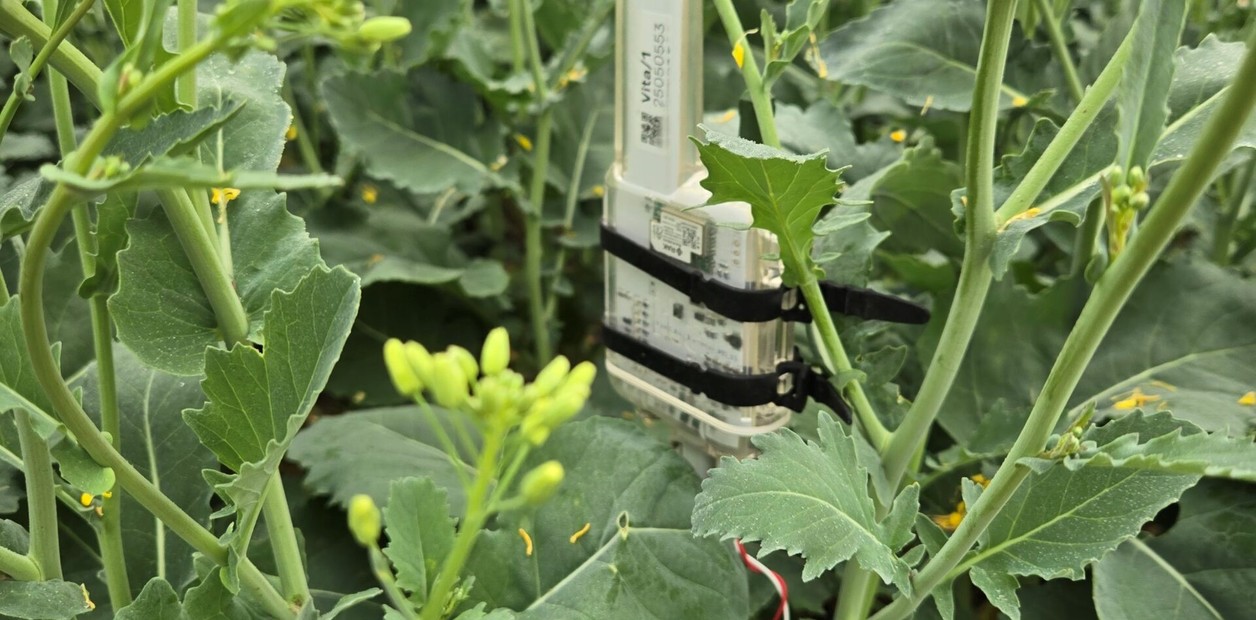
A Swiss company has developed a kind of “electrocardiogram” for plants that can detect in real time whether they are lacking water or nutrients, understand how they react to heat or the application of a product, and anticipate diseases and insects up to ten days before the first visible symptoms appear. This is Vivent Biosignals, an agtech company that launched its technology in Argentina and chose the country as a base for its expansion in Latin America.
The system works with small electrodes placed on the stem, which record the crop’s electrical signals 24 hours a day. Artificial intelligence then processes this information and converts it into alerts for the grower. The company has around 6,000 sensors installed worldwide, has tripled its activity in the last year, and will carry out its first installations in Argentina in September. “The typical approach is to see the symptom of what happened to the plant. It lacked zinc, a white line appears, and that’s it. But by then it’s too late. The most important value we offer is seeing it earlier ,” explained Fernando Derossi, an Argentine, global CEO and partner of the company, during a meeting with journalists in Buenos Aires.
The company has its research and development center in Switzerland and sales offices in the Netherlands. The technology is installed directly on the crop: two small electrodes placed on the stem record the electrical signals generated by the plant, while another sensor measures the local weather conditions. Artificial intelligence analyzes this information and can identify whether the plant is reacting to a lack of water or nutrients, heat, disease, or the presence of an insect.
Derossi explained that this year, during the heat waves in Europe, sensors detected in just one or two days that the plants were suffering from heat stress. “We were able to see it and tell the growers to mitigate it with water,” he said.

The data appears in an app, within a dashboard similar to a traffic light. Green indicates that the plant is within acceptable parameters; yellow warns of a change that should be monitored; and red signals a more serious problem. With this information, the grower can decide whether to irrigate, fertilize, or apply any other treatment. The sensors also show how the crop responds after an application. The dashboard displays the increase in stress when the plant receives the product, how long it takes to absorb it, and when it recovers. The company also aims for the tool not only to report what is happening but also to recommend how to proceed.
“ The added value lies in telling the producer not only what is happening, but also how they can solve it by irrigating, fertilizing, or using a specific product.”
Results vary depending on the crop, environment, and management practices. In a trial conducted at Tomato World in the Netherlands, Vivent Biosignals obtained yield increases of between 10% and 23% in tomatoes. “This increase isn’t seen in every case, but we can say that we’ve generally observed between 2% and 5% increases in many intensive crops,” he explained.
According to the executive, in some cases, costs related to irrigation and energy consumption decreased by around 30%. In Almería, Spain, there were instances where water savings reached 40%. “There are two major benefits: increased yields and reduced input costs. Often, you don’t need to apply any fertilizer, or you need to apply less,” he stated.
With these improvements, he explained, the investment can be recouped with a relatively small increase in production. “In tomatoes, a yield increase of between 0.5% and 0.7% pays for itself. In some crops, like strawberries, a 1% increase in yield pays for itself,” he detailed.

Landing
Initially, the company will focus on working with technologically advanced producers, seed multipliers, food processing companies, and high-value crop farms in Argentina. In large-scale farming operations, it wouldn’t be necessary to install sensors on every hectare: representative plants from different environments would be selected, and the data would be combined with satellite imagery.
To access the technology, producers must purchase the equipment and pay a software subscription. Derossi explained that, as an example, an initial installation of two kits of eight sensors costs between €10,000 and €15,000, including installation and the subscription. The equipment has a proven lifespan of at least three years, and the company is considering offering financing options in Argentina for approximately 36 months.
The first local installations will take place in September using sensors brought from the Netherlands. However, the company plans to begin manufacturing the equipment in Argentina during 2027 , to serve the local market and supply other parts of Latin America from the country. “The idea is that we can produce this same hardware here in 2027,” Derossi stated. The company has already begun searching for potential local manufacturers.

This article has been translated.
Source: LA NACION