
How does a grower know exactly when a crop needs extra nitrogen or potassium? Growers commonly rely on leaf or sap analyses to answer that question. While these analyses provide valuable information, they are labor-intensive, costly, and offer only a snapshot of a plant’s nutritional status at a single moment in time.Clear day-night oscillations appeared, while other changes coincided with VPD, temperature, humidity, irrigation and plant water status.
A practical study conducted in the Netherlands by HAS green academy and Vivent Biosignals suggests there may be another way. In a joint trial with strawberry plants, researchers investigated whether nutrient deficiencies could be detected early by continuously monitoring the electrical signals plants naturally produce. According to the researchers, the initial results are promising: both nitrogen and potassium deficiencies could be identified before visible symptoms appeared.
Electrical signals as a source of information
Plants respond continuously to changes in their environment. Water availability, climate, disease, pests, and nutrient uptake all influence a plant’s physiological processes. These processes are accompanied by small electrical signals generated by the plant itself.
Vivent Biosignals has developed technology that measures these signals continuously. Using two small electrodes inserted into the plant, biosignals are collected and analyzed with artificial intelligence. By combining thousands of measurements from previous studies, specific signal patterns can be linked to particular forms of stress. One application currently under development is real-time monitoring of crop nutrient status.
Practical trial in strawberry
The researchers chose strawberries for the trial, a crop in which the Dutch sector is a global leader in innovation. New varieties, substrate cultivation, LED lighting, and year-round production all require increasingly precise control of irrigation and fertilization.
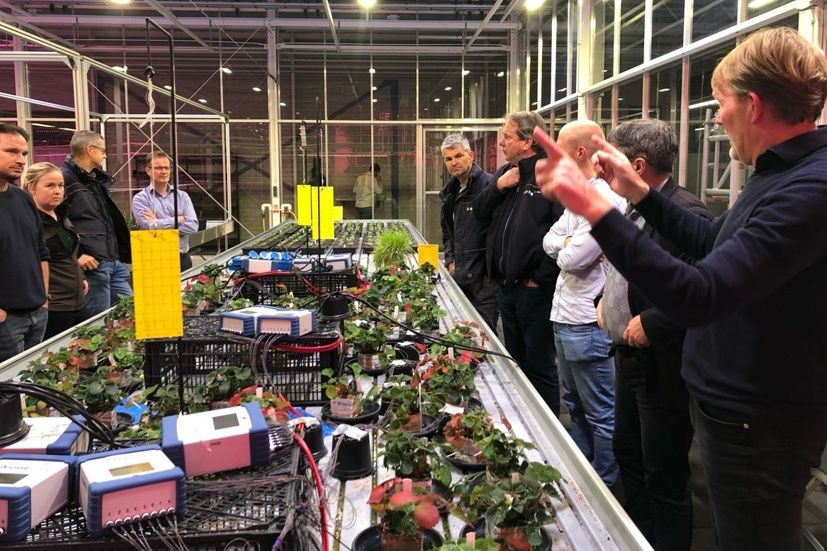
In the greenhouse at HAS green academy in Den Bosch, eighty everbearing strawberry plants of the Florice variety were monitored for nearly one hundred days. Ten biosensors tracked the plants continuously throughout the trial period. Regular crop observations and leaf sap analyses were also carried out to validate the results.
To collect reliable datasets, three treatments were applied: a control group, a nitrogen-deficient group, and a potassium-deficient group. Two weeks into the trial, nitrogen or potassium, respectively, was removed from the nutrient solution for the corresponding groups.
Earlier than the human eye
The trial aimed to further develop models capable of recognizing nitrogen and potassium deficiencies based on biosignals from the plant.
The results show that the models detected an increased likelihood of nutrient deficiency before students and researchers observed visible symptoms such as chlorosis, stunted growth, or abnormal fruit development. This creates the potential to intervene earlier and correct deficiencies before they lead to yield or quality loss.
According to the researchers, this opens the door to a new form of precision cultivation, one in which climate and substrate data are no longer the only inputs for growing decisions, real-time information from the plant itself can now play a role too.
From reactive to proactive growing
Early detection of nutrient stress could offer growers several advantages. By responding more quickly to changes in nutritional status, fertilization can be more precisely matched to crop needs. This can lead to more efficient fertilizer use, lower input costs, and a reduced environmental footprint.
Better nutrient management can also contribute to more stable production and higher product quality. In crops where margins are under pressure and sustainability requirements are increasing, demand is growing for systems that support growers in making evidence-based decisions.
Knowledge sharing with the sector
During the project, HAS green academy and Vivent organized a grower afternoon to update strawberry growers, suppliers, and educational institutions on the trial’s progress. The event revealed considerable interest within the industry in technologies that allow crops to “have a say” directly in cultivation strategy.
Next step
The data collected is being used to further refine and expand the nitrogen and potassium models. Looking ahead, the researchers see potential for offering real-time insight into the nutritional status of various crops, allowing growers to fine-tune growth, yield, and quality even more precisely.
The trial underscores a broader development within horticulture: the shift toward plant-driven cultivation, in which the plant itself increasingly becomes the source of information for daily growing decisions.
The research project was funded by Hagelunie’s innovation fund.