How does it work?
Artificial Intelligence in Agriculture
Enabling precision agriculture worldwide through AI-driven insights from plant data.
AI used for early plant stress detection
Plants constantly communicate through electrical biosignals. These signals contain valuable information about stress, water availability, disease, pests, and environmental changes. Vivent Biosignals uses Artificial Intelligence (AI) to analyse these complex biological signals and transform them into clear, actionable insights for growers, researchers, breeders, and agricultural professionals. By combining plant biosensor technology with machine learning, Vivent Biosignals enables a new generation of precision agriculture, where decisions are driven by the plant itself.
- Up to 25 crop health metrics from a single biosignal
- Predictive insights powered by plant electrophysiology
- AI trained on 1.2+ million plant-days
Our AI Pipeline
Plants constantly generate electrical signals as they react to changes in water availability, temperature, nutrients, pests, diseases, and other environmental conditions. Our agricultural technology operates through a continuous intelligence pipeline:
1. Signal Connection
We begin by capturing high-resolution electrophysiology signals from plants using biosensors. These biosignals serve as the raw data for our models.
2. Data Annotation
Each recording is enriched with metadata such as crop type, substrate, irrigation regime, life stage, and environmental conditions. This structured annotation ensures model accuracy and adaptability and speeds up our product development process.
3. Model development
Trained on the world’s largest plant biosignal dataset (1.2+ million plant-days), our AI detects early stress patterns and generates up to 25 crop health metrics from a single electrophysiological signal, delivering actionable insights in real time.
4. Real-time processing
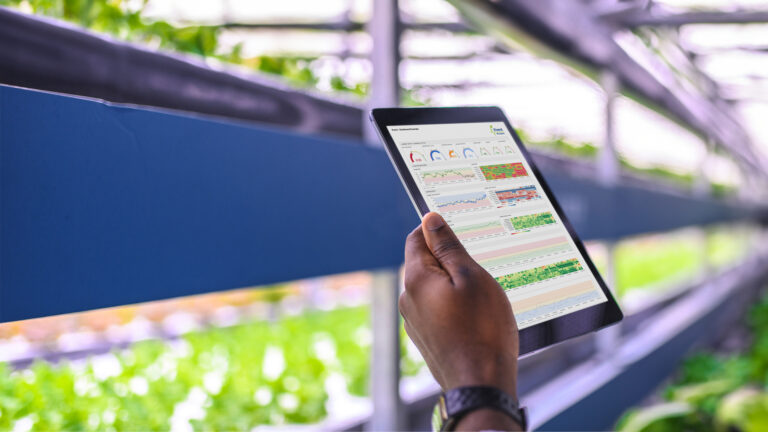
Once deployed, models run directly on sensors or in our cloud, delivering real-time alerts when stress is detected and feeding information to our intuitive, engaging dashboards. This allows growers and agronomists to act, often days before visible symptoms appear.
5. Intuitive, engaging data visualisations
We provide clear crop health metrics designed for either farmers or for plant scientists on dashboards accessible on any connected device.


Application of AI in Agriculture
Our plant driven cultivation technology is used across Controlled Environment Agriculture (CEA), outdoor farming, and Food & Ag inputs to better understand real-time plant responses. By translating plant electrical signals into actionable insights, it supports both research and commercial decision-making.
CEA: In greenhouses and vertical farms, Vivent helps optimise irrigation, nutrition, and climate strategies based on how plants are actually responding, improving control and resource efficiency.
In open-field cultivation, Vivent enables early detection of plant stress before visible symptoms appear, helping growers make faster and more precise interventions under variable conditions.
Seed companies, breeders, and research institutes use Vivent to compare plant responses to stress and evaluate the performance of varieties and inputs with higher precision.
- Earlier plant stress detection before visual symptoms
- Optimised resource use based on real-time plant feedback
- Improved crop performance hroughout the cultivation cycle
Frequently Asked Questions (FAQ)
1. How can I, as a grower, use AI in my cultivation?
- As a grower, you can use AI in cultivation by turning plant and environmental data into real-time decision support for crop management. In systems like Vivent Biosignals, AI analyzes electrical signals directly from plants, combined with climate and growing conditions, to understand how crops are physiologically responding. This helps you move from reactive to proactive cultivation. Instead of waiting for visible signs of stress, AI can detect early changes in plant behavior and translate them into actionable insights for irrigation, climate control, and overall crop steering. In practice, this means AI supports better-timed irrigation, more stable greenhouse climate settings, and earlier intervention when plants show signs of stress, helping improve yield consistency and resource efficiency.
2. How does AI distinguish between normal plant behavior and stress?
- AI distinguishes normal behavior from stress by learning baseline signal patterns for each crop and environment. It then continuously compares live data to these baselines to detect anomalies or deviations that indicate physiological stress or environmental imbalance.
Read more
3. What data sources does Vivent use for AI-based crop monitoring?
- Vivent uses plant-generated electrical signals as the core data source, combined with environmental data such as temperature, humidity, light, and greenhouse climate conditions. This multi-layer data approach improves the accuracy of plant health interpretation.
4. Can Vivent AI be used for different crop types and greenhouse conditions?
- Yes, Vivent’s AI can be applied across different crop types and greenhouse environments. The models are trained to recognize plant-specific signal patterns and adapt to varying growing conditions, making the system flexible for multiple cultivation contexts.
5. How does Vivent convert raw plant signals into actionable recommendations?
- Vivent converts raw plant signals into actionable recommendations by processing them through AI models trained on plant physiology. These models detect patterns linked to stress and growth behavior and translate them into clear insights for irrigation, climate control, and crop steering decisions.
6. How does AI improve crop steering in controlled environments?
- AI improves crop steering by continuously analyzing plant responses and helping growers adjust cultivation strategies based on real-time feedback. This leads to more precise control over growth conditions, improved resource efficiency, and more consistent crop performance.
Are you interested in learning more about using AI in your cultivation?
Get in touch with us.
Fill out the form below or book an online meeting directly with one of our team members.