Energy savings, smarter irrigation and biostimulant performance insights at Harry Wubben Flowers.
Vivent Biosignals x Harry Wubben Flowers Energy savings, smarter irrigation [...]
Energy savings, smarter irrigation and biostimulant performance insights at Harry Wubben Flowers.
Harry Wubben Flowers, located in Nootdorp, the Netherlands, has specialized in growing chrysanthemums for over 35 years. Today, the company primarily cultivates Santini chrysanthemums, a variety characterized by its many small blooms on a single stem. The nursery covers a total cultivation area of 60,000 m².

“We were able to reduce the lighting setting from 8 to 5, aligning the lighting with the plants’ actual needs. The impact was already visible within the first few days.”
Harry Wubben, Harry Wubben Flowers

Like many growers, Harry Wubben Flowers relied on experience, visual observations, and climate data to make cultivation decisions. While effective in many situations, these methods could not reveal how the plants themselves were responding to changing environmental conditions in real time.
This created three key challenges:
Limited visibility into plant stress
Young Santini chrysanthemums experienced stress from artificial lighting before any visual symptoms appeared. Without direct feedback from the plants, lighting strategies were based on assumptions rather than the crop’s actual physiological needs.
Irrigation based on estimates
Irrigation decisions were made using climate conditions, substrate measurements, and grower experience. Although these are valuable indicators, they do not reveal whether the plant itself is experiencing stress or actively requires water.
No objective insight into recovery and treatment performance
After events such as high radiation, crop protection applications, or changing weather conditions, it was difficult to determine how quickly plants recovered. Likewise, the effectiveness of biostimulants could only be assessed through visual observations and experience, making objective evaluation challenging.
By continuously listening to the plants’ electrical signals with Vivent Biosignals, Harry Wubben Flowers gained a completely new layer of insight into crop performance, enabling more precise and confident cultivation decisions.
Lighting optimized to plant demand
Vivent’s plant driven insights showed that young plants were receiving more artificial lighting than they actually required. By aligning the lighting strategy with the plants’ real-time physiological needs, the grower reduced the lighting setting from level 8 to level 5. The positive effect was visible within the first few days while simultaneously reducing energy consumption.
Plant driven irrigation
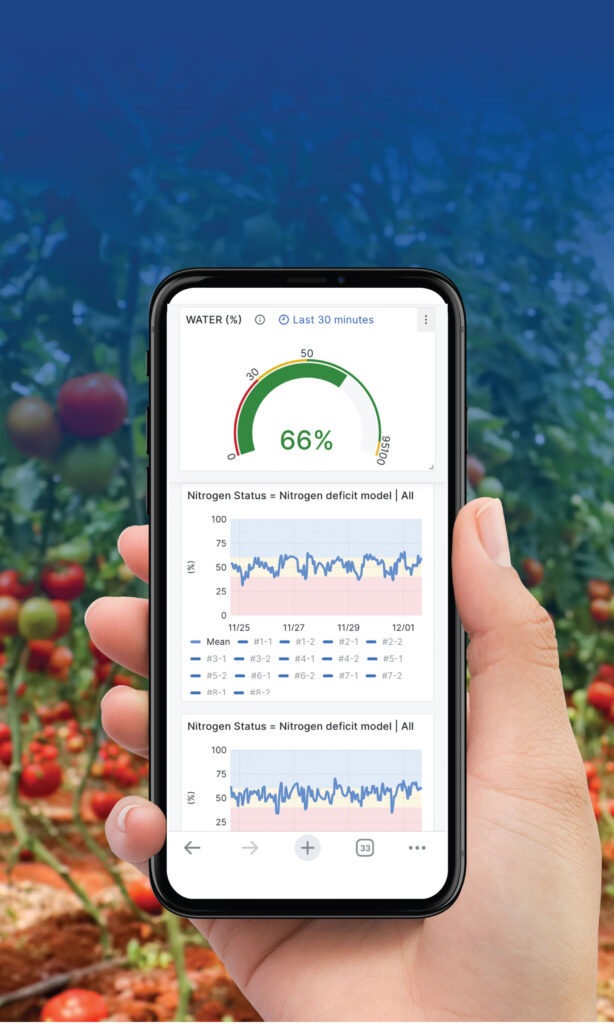
Instead of relying solely on environmental data, irrigation decisions are now supported by direct feedback from the crop itself. This allows irrigation to be applied when the plants actually need it, improving water use efficiency and maintaining a healthier crop.
Objective validation of biostimulants
Vivent Biosignals made the plants’ recovery process measurable. Comparative trials clearly demonstrated that crops treated with biostimulants recovered more quickly after stress events such as spraying or periods of high radiation, providing objective evidence of product performance.
Rather than responding only after visual symptoms appear, growers can now detect stress earlier and make informed interventions before crop performance is affected. This results in healthier plants, greater operational confidence, improved resource efficiency, and more consistent production throughout the growing season.
By integrating plant feedback into daily cultivation decisions, Harry Wubben Flowers was able to align climate control more closely with the actual needs of the crop. Instead of steering solely based on environmental conditions, cultivation decisions were supported by insights into how the plants themselves responded.
Why it matters
This case demonstrates the value of plant-led growing. By gaining real-time insight into plant responses, growers can optimize crop performance while reducing unnecessary use of energy and other resources. Understanding what plants need, when they need it, enables more precise decisions, improved crop quality, and more sustainable production.
Plants know best — and now they can show it.
“Before, we made decisions based on what we thought the plant was experiencing. Now, we can truly measure and understand what the plant is telling us, what it needs, and how it responds.”
Harry Wubben, Harry Wubben Flowers
Fill out the form below or book a meeting directly with one of our team members!
Vivent Biosignals x Harry Wubben Flowers Energy savings, smarter irrigation [...]
Vivent Biosignals x Van Schie x Ledgnd Van Schie prevents [...]
Vivent Biosignals x Morao Arándanos x Green Laniel 30% cost [...]
European Innovation Project Autonomous, AI-driven crop management based on electrophysiological [...]
Symactiv x Vivent Biosignals x Jucker Farm AG Quantifying the [...]
Symactiv is a Swiss biostimulant provider focused on restoring soil biology to turn depleted soils into productive, resilient growing systems. By rebuilding biological balance underground, Symactiv helps crops access water and nutrients more efficiently, delivering consistent performance year after year.
Jucker Farm AG, located near Pfäffikersee in Switzerland, is a progressive vegetable producer growing potatoes and tomatoes under demanding climatic conditions. Like many growers, Jucker Farm continuously evaluates new agronomic solutions that can improve crop resilience and input efficiency without adding operational complexity.

“Using Vivent’s solution, we could see when and why our biostimulant makes a difference. We were delighted to get quantified evidence of the benefits in water and nutrient status for crops treated with Symactiv.”

Philippe Schläpfer, Symactiv Co-founder and CTO

Despite implementing regenerative practices and maintaining soils in good apparent condition, the farm faced several persistent challenges according to standard crop analysis:
To objectively quantify the impact of Symactiv’s soil enhancer, we deployed Vivent’s plant-based sensing technology directly in the field.
Across potato and tomato trials, Vivent plant sensors were installed in:
Rather than relying solely on yield or visual assessments, Vivent Biosignals continuously monitored:
This approach allowed Symactiv and the farmer to compare treatments under identical environmental conditions, isolating the biological effect of the biostimulant.
1. Improved Plant Stability and Resilience
2. Better water status under stress
3. Enhanced nutrient uptake
For Symactiv, these trials provided independent, plant-level evidence explaining why and when their biostimulant delivers value — strengthening both product development and customer communication. Treated plants showed substantial yield increases of approximately 15% compared to untreated plants for these specific crop cycles.
For Jucker Farm, the results validated Symactiv as a practical, field-ready solution that integrates seamlessly into existing operations while improving crop resilience.
Why it matters
This collaboration demonstrates how plant-based biosignal monitoring enables biostimulant providers and growers to move beyond trial-and-error toward evidence-driven agronomy.
By letting plants themselves report on stress, water, and nutrient dynamics, Vivent helps partners like Symactiv:
Plants know best — and now they can show it.
“Symactiv turns good ideas into practical, field-ready solutions. It fits seamlessly into our operations and has real potential for broader adoption.”
Martin Jucker, Jucker Farm AG

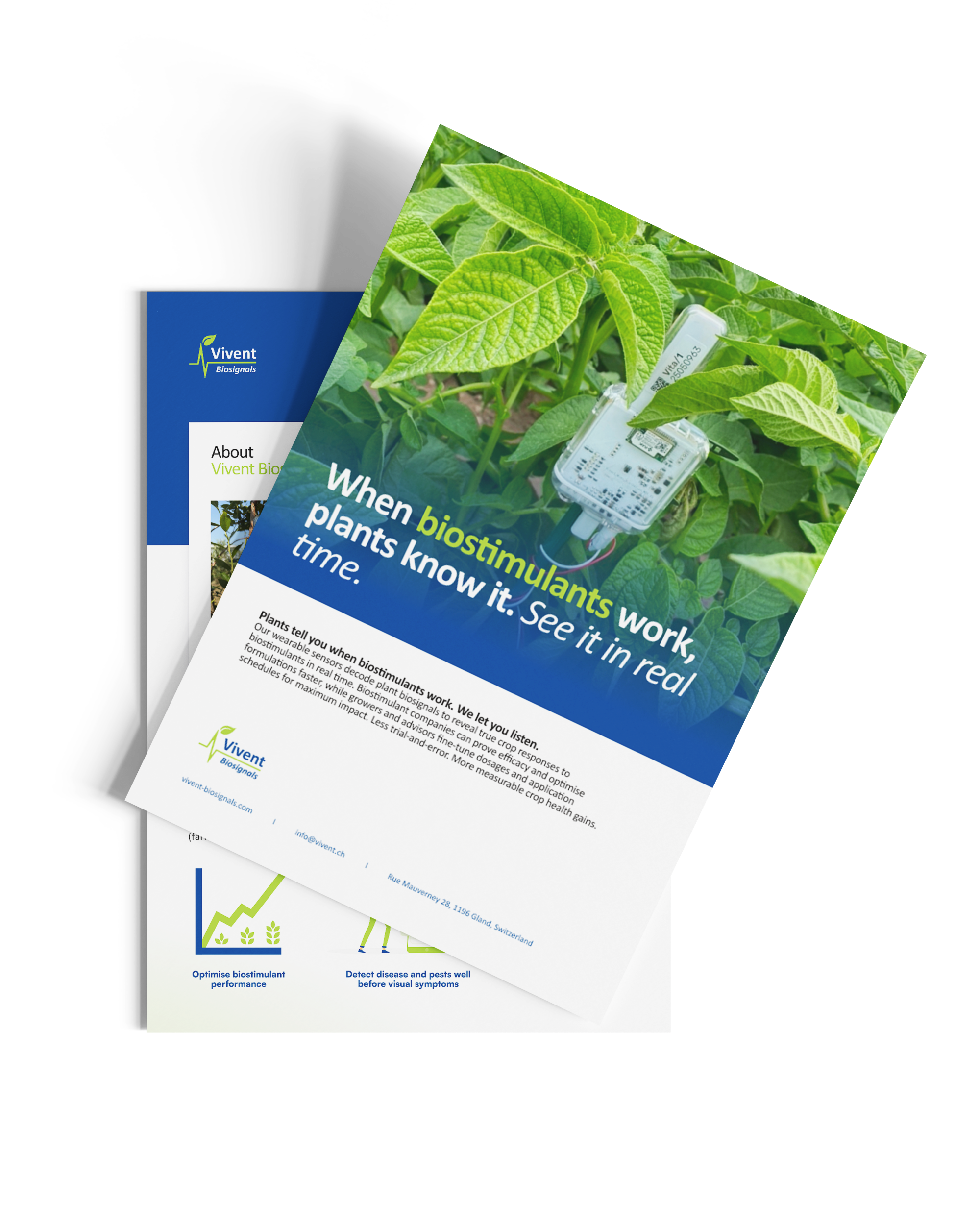
When biostimulants work, plants know it. See it in real time.
Our wearable sensors decode plant biosignals to reveal real-time crop responses to biostimulants. Biostimulant companies can demonstrate efficacy and optimise formulations faster, while growers and advisors fine-tune dosages and application schedules for maximum impact. Less trial-and-error. More measurable crop health gains.
Discover the added value of Vivent for biostimulants through field cases and more in our biostimulant brochure.
Fill out the form below or book a meeting directly with one of our team members!